
Updated 2026-11-18
Repair or replace, with both prices on the page
Repair and replacement are both real options, and they belong on the same conversation. You approve a fixed price before work starts, whether the job is a capacitor or a new matched system. Age is a fact, and age, by itself, is only part of the decision. This guide is how we decide which number belongs on the quote.
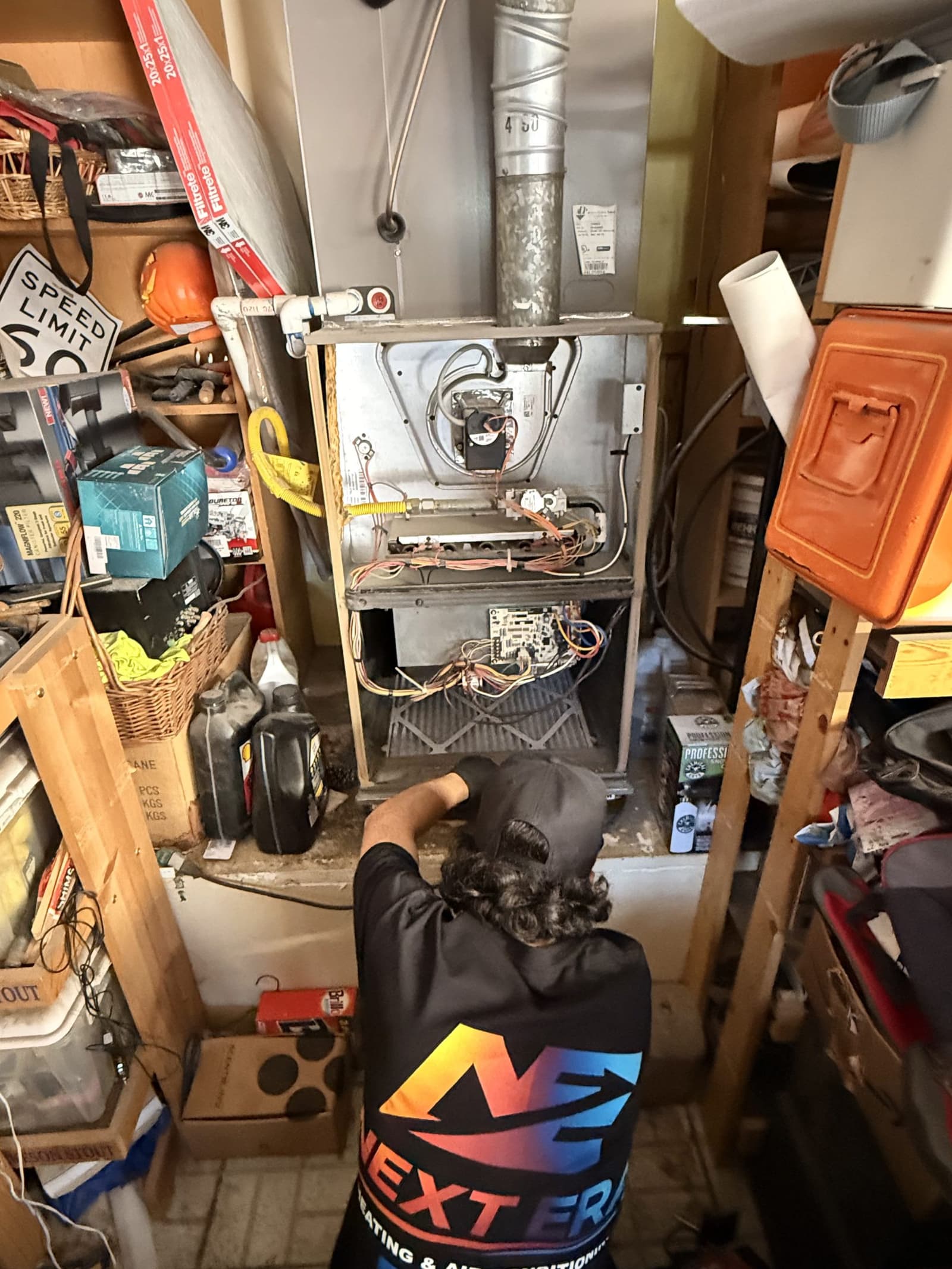
What a repair visit is
A repair starts with the symptom and the equipment. The air conditioner is off, short-cycling, or running without cooling the house. The furnace will not light, or it lights and trips, and the heat pump ices up, or it blows lukewarm air and never reaches the setpoint. We find the failed part, or the failed condition, and we price the repair before any parts go in.
The floor for that visit is. It covers the diagnostic visit that turns into a repair. A capacitor, a contactor, a flame sensor, or an igniter is a different price from a compressor, an evaporator, or a heat exchanger, and each of those prices is fixed before we start. If the filter or the thermostat setting was the whole problem, we say that too.
The seasonal tune-up is maintenance, not a repair. It covers the filter, the coils, a refrigerant check, the electrical side, the thermostat, and a written summary. If that visit finds a failed part, the repair is a separate fixed price, and the maintenance plan is two seasonal visits, priority scheduling, and a repair discount. Parts stay outside the plan, and restrictions on offers may apply, so call for details.
Parts that are repairs
Capacitors and contactors fail in the first hot week because they have been marginal since last September. A condenser coil packed with corridor dust, cottonwood, or Santa Ana grit overheats a system that is otherwise sound. A blower capacitor, a fan motor, or a clogged condensate line is a repair. On the heating side, igniters, flame sensors, inducers, and pressure switches are repairs when the heat exchanger is intact and the vent is clear.
We replace the failed part and prove the system runs. A compressor that will not start gets tested after the start components are known to be good. A compressor that has failed electrically or mechanically is a larger repair, and that price is where replacement deserves a seat at the table. Both numbers can be on one page, and you pick.
Refrigerant work is a repair when the leak is found and fixed and the system is worth keeping. Existing R-410A systems can be serviced. A2L refrigerants such as R-454B and R-32 are not a drop-in for those systems, and low charge means a leak. If the leak is in an old evaporator, the repair price and the replacement price are both written down.
When replacement is the honest job
A cracked heat exchanger is a replacement, and we keep a patched heat exchanger out of a living space. A compressor and an evaporator that fail together on an older system, with tired ducts and a condenser coil that is rotten, is a replacement conversation. A system that has had the same leak repaired twice is a replacement conversation. The pattern matters more than a slogan.
Some contractors use a percentage rule, and we would rather show the two fixed prices and the condition of the ducts, the panel, and the refrigerant circuit. A small part on a mid-life system is a repair. A large sealed-system repair on an old pair, with ducts that need work anyway, is a different sheet of paper. Duct replacement is quoted after we see the job when the flex is crushed or disconnected.
The repair-to-replacement credit exists for the household that pays for a major repair and then decides, within the offer's terms, to replace the system. The credit applies the repair toward the replacement, and restrictions may apply, so call for details. A free second opinion is available if you have already been told you need a new system. A free replacement estimate is available if you are ready to compare equipment.
What replacement includes, and what it does not
A full system replacement is quoted after we see the job, and a heat pump has its own price on the quote, and every complete install includes a free smart thermostat, and the quote names the model. Ask about current offers on a qualifying new system, and about current offers for seniors, military, and first responders, and when ductwork is replaced with the system. Restrictions may apply, so call and we will say which offers fit, and these offers have no end date.
The quote lists the equipment, the certified SEER2, and the EER2 or HSPF2 that applies. It lists what happens to the old gear, the pad or the curb, the line set, the disconnect, haul-away, and the permit. Crane work on a rooftop package is in the price when the roof needs a crane. A panel that is short a circuit for the new equipment is in the price, or it is named as an exclusion, and you should see that before the day starts.
Ducts are the piece you feel later, and a new condenser on disconnected flex leaves the back bedroom waiting. If we recommend leaving the ducts, we say why. If we recommend replacing them, the number is on the same quote, and cleaning is for intact ducts. Crushed, wet, or disconnected ducts are a replacement conversation.
Age, brand, and the stories that are not diagnoses
A manufacture date is a useful fact. It tells us the refrigerant, the parts channel, and roughly how long the system has sat in an attic that spends July well above the outdoor temperature. The compressor still gets a test; Goodman, LG, Carrier, Trane, and other brands all sit in these attics. We service them, and a failed capacitor is indifferent to the name on the corner post.
R-410A, with a GWP near 2,090, is still the correct refrigerant for the systems built for it. New equipment is a different product, built for R-454B, R-32, or whatever the label says, under the EPA GWP limit of 700 for new residential and light-commercial air conditioners and heat pumps. The manufacture and import restriction is January 1, 2025, and a May 2026 EPA final rule, effective July 27, 2026, allows pre-2025 manufactured or imported inventory in those categories to keep being installed. VRF dates have shifted, and those jobs confirm the current EPA text; none of that is a reason to scrap a repair that would have fixed a capacitor.
Warranty length is the manufacturer's document and the installing contractor's registration. If a system is under a manufacturer warranty, bring the paperwork. We will tell you when a warranty part changes the price, and we will service the equipment either way, at a fixed price.
A practical order of operations
If the house is hot or cold right now, the repair visit is the first call. Running without cooling, or not running at all, can be diagnosed during open hours when the board allows; Monday-Saturday, 7:00 AM - 8:00 PM, Sunday, 7:00 AM - 4:00 PM, (951) 713-7529. Tell us whether the outdoor unit is humming, whether the indoor blower is moving air, and whether you have changed the filter. Those three facts keep the first hour useful, and leave the electrical compartment closed.
If the system is old and you are planning rather than sweating, the replacement estimate is the first call. Have the age, the last repair, and a note about which rooms lag, and we look at the ducts and the panel before we talk about SEER2. The Southwest minimums for a new split air conditioner are real, and they live in the SEER2 guide. A contactor is still a contactor.
If you are between the two, ask for both prices. A repair number next to a replacement number is enough to decide without a script. The company is based in Rancho Cucamonga, and holds CSLB #1162322.
Second opinions and pressure
A free second opinion is for the day someone has already told you the system is finished. We look at the equipment, and if the first diagnosis was right, we will say so. If the failed part is a capacitor and the compressor runs, we will say that too. The opinion is yours, and it is separate from an obligation to buy a system from us, and restrictions may apply, so call for details.
Pressure sounds like a clock, and a price that is good today only is a clock. Our offers have no end date, and if a price is fixed, it is fixed for the scope we wrote down. If the attic shows a disconnected trunk we could not see from the ladder, we stop and reprice before we continue. Same rule, new facts.
You can also wait, if the system is safe and you can live with it. A furnace that trips a safety is outside that category, and a heat exchanger question is outside it too. An air conditioner that is merely expensive to run, and is otherwise safe, can wait until you are ready. The learning center is here so the wait is useful.
HVAC Repair
System Replacement
AC Repair
Furnace Repair
Questions
Is a seasonal tune-up a repair?
Do you use a fifty-percent rule?
Can today's repair be credited toward a new system?
Should I replace the system because of the refrigerant change?
Based in Rancho Cucamonga
Ready for a fixed price?
Call us, or send a note. You hear the price before we start.