Updated 2026-11-18
R-410A, R-454B, and R-32, without the charging steps
Residential air conditioners and heat pumps are in the middle of a refrigerant change. R-410A, the refrigerant in most systems from the last two decades, has a global warming potential of about 2,090. The replacements you will see on new equipment, R-454B and R-32, sit near 470 and 675. The federal line for new residential and light-commercial air conditioners and heat pumps is a GWP limit of 700, and this page is the house version; charging steps stay with the technician.
Three refrigerants, three numbers
Global warming potential compares a gas with carbon dioxide over a set time, and it is separate from whether the refrigerant cools your house. R-410A, the blend that replaced R-22 in new equipment years ago, sits at about 2,090; R-454B, one of the A2L blends now used in many new central systems, sits at about 470. R-32, common in ductless equipment and in some central systems, sits at about 675, and the tables vary a little by source. The order stays put; R-410A is far above the new limit; R-454B and R-32 are under it.
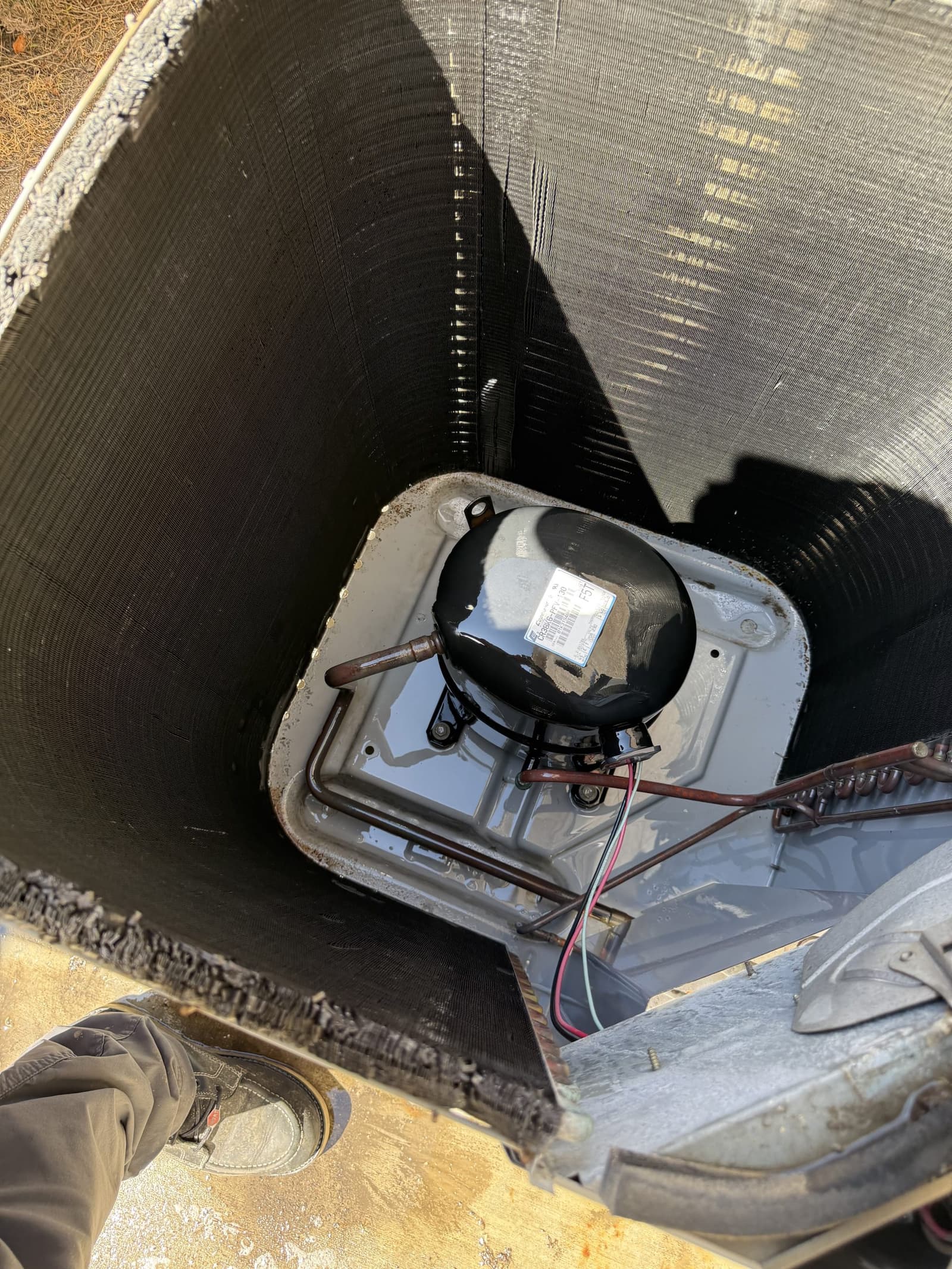
The Environmental Protection Agency's GWP limit of 700 applies to new residential and light-commercial air conditioning and heat pump equipment. That is why new condensers and new mini-splits wear different labels than the equipment in a 2014 attic. The label on your outdoor unit is the one that tells us what is in it. We read that label before we talk about parts.
GWP is an environmental rating. Refrigerant belongs in the circuit it was charged into, handled with recovery equipment. Our license is CSLB #1162322. The environmental rule and the contractor license are two different documents, and a quote can respect both.
The manufacturing and import date
The manufacture and import restriction for the affected residential and light-commercial equipment landed on January 1, 2025. Equipment built or imported for those categories after that date is held to the lower-GWP refrigerants. That rule is about the factory and the port. Your existing R-410A system stayed legal to own.
Houses all over the Inland Empire, Riverside County, and Orange County are full of R-410A systems with useful life left. A failed capacitor, a pitted contactor, or a dirty coil on one of those systems is a repair. Repair visits are quoted after we see the job with a fixed price before parts go in. The calendar is a poor reason to condemn a system, and a failed compressor, coil, or heat exchanger is a diagnosis.
New installations are a different pile of equipment. A full system, a heat pump, and a ductless zone are each quoted after we see the job. Whatever we set has to be legal to install on the day of the permit, and it has to use the refrigerant the manufacturer designed that model for. The quote names the refrigerant, so you can read it before we leave.
Existing R-410A can still be serviced
Existing R-410A systems can be serviced. That includes leak repair, component replacement, and the refrigerant work a sealed-system repair actually requires, done by a technician with the right certification and recovery equipment. Parts and refrigerant follow the market, and if a specific part is no longer made, we say so and we price the alternative. A rumor is a weak reason to replace a working system.
Low refrigerant is a leak, and adding refrigerant and leaving the leak is how the same call happens next July. We will find the leak, or we will tell you the leak is in a coil or a line set that is a poor chase on an old system. Both answers come with a fixed price. With a GWP near 2,090, keeping the gas in the system is the kinder path for the equipment and the air.
The seasonal tune-up includes a refrigerant check. A check is a measurement and a report. The maintenance plan includes the seasonal visits and a written note. If the check shows a problem, the repair is quoted before anyone opens the circuit.
A2L refrigerants are not a drop-in
R-454B and R-32 are classified A2L, which means they are mildly flammable under the safety standard's lettering. R-410A is in a different class, and the new refrigerants are not a drop-in for R-410A. The oils, the pressures, the parts, and the safety design are different. Putting an A2L refrigerant into a system built for R-410A is a field conversion we leave alone, and it is a project to keep off the weekend list.
New A2L equipment is built for the refrigerant on its label. It may include sensors, different electrical protection, and charge limits the old R-410A cabinet skipped. We install those features the way the manufacturer designed them, and if a line set can be reused, the quote says so after it is inspected. If size, condition, or the manufacturer's note says otherwise, the quote includes a new line set.
This page stops before any charging procedure. There are no target pressures here, no superheat or subcooling targets, and no cylinder steps. That work belongs to the technician, with gauges, a scale, and recovery equipment. If your system is low, flat, or iced over, turn it off and call, and a can from the parts counter is a hard way to help a sealed system.
The May 2026 rule on existing inventory
A May 2026 EPA final rule, effective July 27, 2026, allows residential and light-commercial equipment that was manufactured or imported before 2025 to keep being installed. Read that as an inventory rule. It covers equipment that already existed in the channel before the manufacture and import restriction. It is separate from permission to build new high-GWP equipment, and it is separate from assuming every R-410A condenser on a shelf fits every house forever.
We install what is legal on the day we pull the permit, and we say which rule the equipment is riding. If a job uses pre-2025 inventory that the July 27, 2026 rule allows, the quote can say that. If the job uses new lower-GWP equipment, the quote says that. The service refrigerant for the next fifteen years follows the label.
Dates in this area have moved before, and they can move again, and this page is dated November 18, 2026. If you are reading it later, confirm the current EPA text before you lean on a paragraph about inventory. We would rather amend a quote than defend an old sentence. The same caution applies, even more, to variable refrigerant flow.
VRF dates have moved
VRF, and VRV, the name one manufacturer uses for the same idea, is a multi-zone system for light-commercial buildings and some large houses. Several indoor units share one outdoor unit, each on its own setpoint. The EPA timeline for variable refrigerant flow has shifted. We keep a cutoff date off this page so a tenant improvement in Ontario or Irvine is permitted against the current text.
Confirm the current EPA text for VRF before a project is ordered, and we do that as part of a quote, which is why VRF is quote-only. A site visit counts zones, line lengths, electrical service, and controls, and then a fixed price follows. A campus central plant is outside the work we should imply we chase. A small office, a tenant improvement, or a multi-zone building is the work.
A residential ductless system with two indoor heads is still a mini-split. A multi-zone mini-split is quoted after we see the job per zone and described in the mini-split guide. Mixing the names is how a simple ADU gets a commercial proposal. The refrigerant on a new ductless system is the one the manufacturer built it for, often R-32, and it is still not a drop-in for the R-410A system on the main house.
What to ask, and what we will not do
Ask what refrigerant is in the system you have, and what refrigerant is in the system being proposed, and ask whether the indoor coil is matched to it. Ask whether the install is new lower-GWP equipment or pre-2025 inventory covered by the rule that took effect July 27, 2026. Ask for the price fixed before work, and for the license, which on our quotes is CSLB #1162322. Those questions are enough, and you can be an informed customer with both feet on the ground.
R-454B and R-32 stay out of an R-410A system; charging steps stay off this page. An existing system is replaced when age, leaks, safety, or the repair price say so. A high GWP number, by itself, is a label, not a sentence to scrap the equipment, and the repair-or-replace guide walks through that choice. A free second opinion is available if someone has already used the refrigerant transition as a scare, and restrictions on offers may apply, so call for details.
Next Era works from Rancho Cucamonga, Monday-Saturday, 7:00 AM - 8:00 PM, Sunday, 7:00 AM - 4:00 PM, at (951) 713-7529. We service Goodman, LG, Carrier, Trane, and more, and the refrigerant label matters more than the brand story. Bring a photo of the outdoor data plate if you want the first conversation to start with the right gas. This is the homeowner version, not a filing.
HVAC Repair
System Replacement
VRF / VRV Commercial
AC Repair
Questions
Can you still repair my R-410A system?
What are the GWP numbers I should remember?
Is a new mini-split refrigerant a refill for my central system?
Why will you not list a VRF cutoff date?
Based in Rancho Cucamonga
Ready for a fixed price?
Call us, or send a note. You hear the price before we start.