Updated 2026-11-18
A maintenance checklist that stays short on purpose
Maintenance is the work that happens before a capacitor opens on the first 100°F afternoon, or a furnace fails on the first cold morning. The seasonal tune-up is one visit. The plan adds a second visit, priority scheduling, and a discount on repairs. This page is the short list of what those visits cover, what you can do between them, and what stays with a technician.
Two seasons, two visits
The area we cover has a cooling season that gets serious in late spring, and a heating season that shows up first on foothill and pass nights. Coastal Orange County leans on cooling and corrosion. Beaumont, Banning, and Yucaipa lean harder on the heating visit, and two visits line up with those seasons. One before the heat, and one before the first night you actually need the furnace or the heat pump.
The plan is our maintenance plan, or the yearly total on the same plan, and it covers the seasonal visits, priority scheduling, and a repair discount. Parts and repairs are quoted on their own, at a fixed price, before any work starts. The plan is a maintenance plan, and if a repair is needed, you hear the price and you approve it. Priority scheduling puts plan members toward the front of the board when the first hot week fills the calendar, and it is a place in line, not a promised minute.
The single-visit tune-up is a fair way to have a technician look at a system you just inherited with a house, or a system you have been ignoring. If the system is already dead, the visit is a repair, priced as a repair. Restrictions on offers may apply, so call for details. The tune-up offer has no end date.
What the visit covers
The list is short on purpose, and we check the filter and the filter slot. We look at the coils, outdoor and indoor, and we clean the outdoor coil when it is loaded. We check the refrigerant, which means we measure and we report, and a low charge is a leak, and existing R-410A systems can be serviced. A2L refrigerant is not a drop-in for a system built for R-410A; charging steps stay with the technician on site.
We check the electrical parts that fail in this climate: capacitors, contactors, the disconnect, and the connections that loosen in a hot attic. We check the thermostat, including whether a heat pump is set up as a heat pump. We check the blower and the temperature split, the difference between return air and supply air. You get a written summary of what we found and what, if anything, needs a repair price.
That is the visit, and it is separate from a duct replacement, a panel upgrade, or a treatment of the air. If the ducts are disconnected, the summary says so, and duct replacement is quoted after we see the job and cleaning is the right job only when the ducts are intact. If a safety control on a furnace has tripped, we leave it in the safe position and quote the repair. Heating and cooling repairs are their own fixed prices when the system has already failed.
What you can do between visits
Look at the filter on a monthly rhythm, and change it when it is loaded. The MERV rating has to be one the blower can pull, and a one-inch high-MERV pleat in a shallow slot can starve the coil. The indoor-air guide covers that, and write the size on the furnace door so the next filter matches. The arrow on the frame points toward the blower.
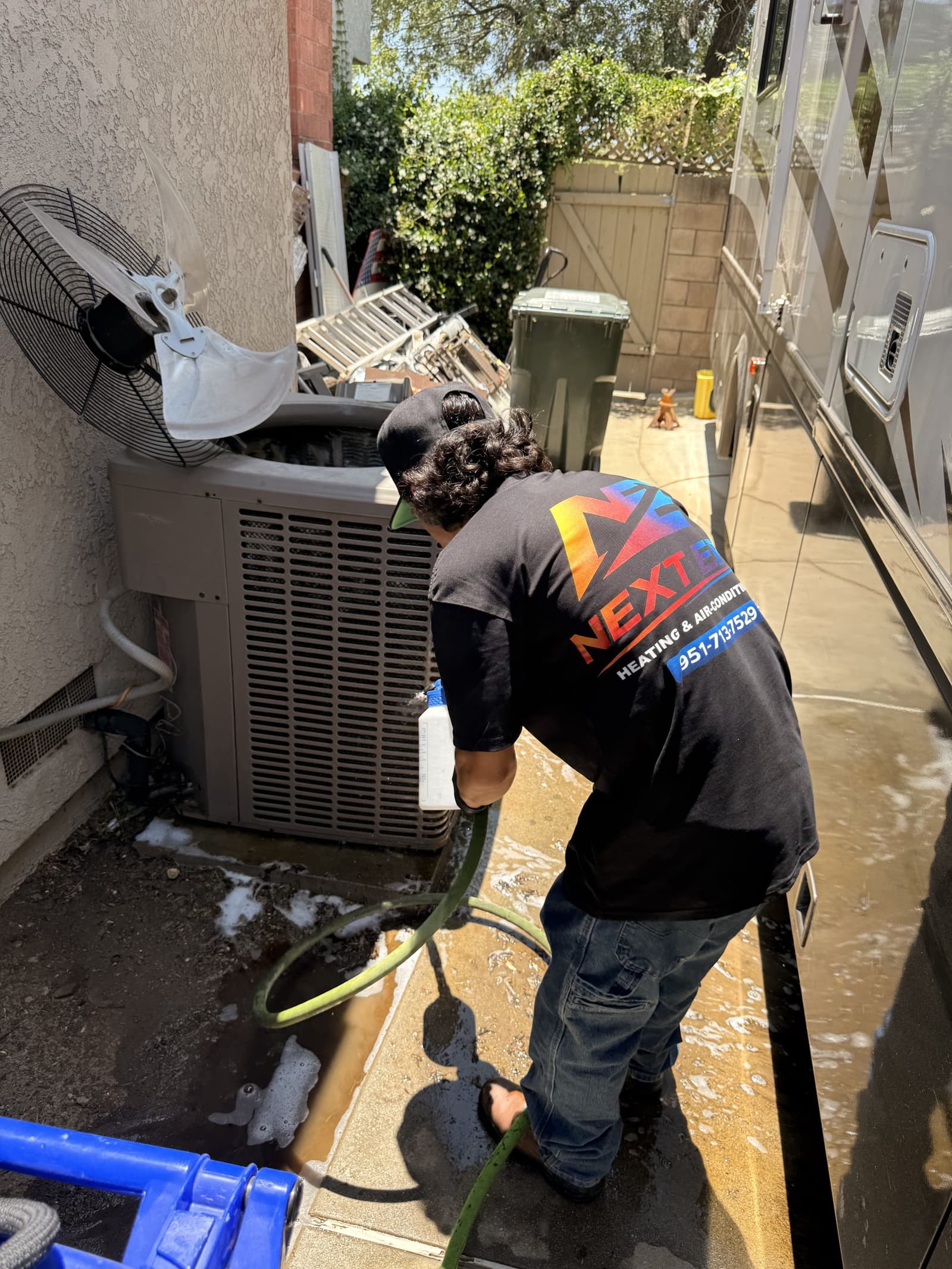
Keep the outdoor unit clear; leaves, palm fronds, and a new fence that blocks the discharge are ordinary reasons a system trips on a hot afternoon. You can rinse the outside of the condenser with a hose if the power is off at the disconnect and you stay out of the fan. You are rinsing the outside, and if the unit made a new noise after a Santa Ana wind, leave it off and call. Debris inside the grille is a technician's problem.
In heating season, keep the furnace closet clear. Stored paint, a blocked return, and a flue that a remodel enclosed turn a tune-up into a safety conversation, and one reset after a filthy filter is reasonable. Repeated resets mean a limit, a rollout, or a flame sensor is asking you to stop, and leave safety switches in the circuit. If a carbon monoxide alarm sounds, or you smell gas, leave the house and call the gas utility's emergency line and the fire department, then call us for the repair once the house is safe.
Cooling-season failures we are trying to get ahead of
Capacitors fail when the attic and the outdoor air have been high for a week, and a tune-up in April or May catches the ones that are already weak. It gives a capacitor a head start, and it still leaves September as September, and you are less likely to discover a dead system on the first Monday over 100°F with everyone else in the valley. Contactors pit, and outdoor coils in Fontana and along the warehouse corridors pack with dust. A coil rinsed in spring can be matted by August, which is why a mid-season look still helps if you can see the fins loaded.
A refrigerant check in spring tells us whether the system is tight going into the season. A system that is low in May will be lower in July, and it will ice or trip when you can least afford it. Finding the leak is a repair. The tune-up's job is to find the condition and write it down with a price.
A schedule that lets the house float high while you are out, then asks for a deep drop at 5 p.m. on a 105°F day, makes a correct system look small. The equipment spends the peak hours pulling heat the structure stored all afternoon. We will mention that in the summary when we see it. A deeper setback is a comfort choice, and the equipment still has to catch up.
Heating-season failures we are trying to get ahead of
Furnaces in this region sit idle for months, and dust settles on a flame sensor, and an igniter that was marginal in March opens in November. Inducers and pressure switches complain after something nested in a vent over the summer. The fall visit exists so those parts are found while the days are still mild. Yucaipa, Beaumont, and Banning get the cold nights first; their fall visit is the one to keep.
Heat pumps need a different look, and the reversing valve, the defrost control, and the thermostat settings are the heating system. Auxiliary electric strips should be available, and they should stay backup. A furnace thermostat left on a heat pump will confuse this. The fall visit confirms the mode before the first cold night, and it confirms the outdoor unit is clear enough to ice evenly if it ices at all.
Combustion safety stays firm. A furnace that rolls out, a heat exchanger that is suspect, or a vent that fails to draft gets shut down and quoted as a repair or a replacement. System replacement is quoted after we see the job, and a heat pump has its own price when it is the right replacement. The written summary will say that plainly, and the fixed price will follow the diagnosis.
What maintenance cannot do
A tune-up leaves the duct layout where it found it, and it leaves a fifteen-year-old compressor at that age. It can find a return that is open to the attic and price the repair, and it is separate from a Manual J. If the comfort complaint is a design problem, the summary can say so. The sizing guide explains why a typical-house tonnage stays off our quotes.
The plan discount applies to repairs you need. When replacement is the right job, the repair-to-replacement credit may apply a major repair toward the new system. Restrictions may apply, and a free second opinion remains available if another company has declared the equipment dead. A sound system can stay on the plan.
Filters, coil washes, and written notes leave the permit rules where they are for the day you replace the system. They help the system you have stay closer to the performance it was installed to deliver. A strong nameplate still assumes a clean coil and the right airflow. The visit is how you get back toward that assumption.
How to schedule and what to have ready
Call (951) 713-7529, Monday-Saturday, 7:00 AM - 8:00 PM, Sunday, 7:00 AM - 4:00 PM, or send a request through the contact page. Say whether you want the single tune-up or the plan, and whether the system is heating, cooling, or both. Have the filter size if you know it, the age of the outdoor unit if it is on the data plate, and the gate code. If the furnace is in the attic, know where the access panel is; clearing boxes off that hatch before we arrive is the difference between a visit and a reschedule in July.
Next Era is based in Rancho Cucamonga. The license is CSLB #1162322. We service Goodman, LG, Carrier, Trane, and more. Bring any paperwork from the installer if the system is young.
If you just moved in, the new-homeowner offer is a reason to have the system checked before it surprises you. The offer is listed as ask, and the figure is part of the call. Restrictions may apply, so call for details. The first summer in an Inland Empire house is when people wish this had happened in April.
Maintenance Plans
AC Repair
Furnace Repair
Heating Repair
Questions
What does the maintenance plan cost?
How is the plan different from the seasonal tune-up?
Will you add refrigerant during a tune-up if it is a little low?
Do you maintain every brand?
Based in Rancho Cucamonga
Ready for a fixed price?
Call us, or send a note. You hear the price before we start.