
Updated 2026-11-18
MERV ratings, airflow, and what we will not claim
On this site, indoor air means filtration the blower can actually pull, ducts that are connected, and equipment clean enough to move air. MERV is the rating on a filter, and a higher number catches smaller particles and adds resistance. A filter, an air scrubber, or a duct cleaning is a maintenance tool. Health questions belong with a physician.
What MERV is measuring
MERV, Minimum Efficiency Reporting Value, is a test rating for how a filter captures particles across a range of sizes. A higher MERV number means the filter caught more of the particles in the test, including smaller ones. The number describes the filter in the test rig. Your return slot is a different opening.
Most one-inch slots in Inland Empire tracts were built around a coarse filter, the kind that keeps lint off a coil. Moving that slot to a high-MERV one-inch pleat, without more surface area, is how a filter becomes a blockage. The blower was selected for a lighter load, and the coil sees less air, and in cooling, the coil can ice. In heating, a gas furnace can trip its limit, and the house feels stuffy, and the filter looks impressively dense when you pull it out.
A deeper rack changes the math, and a 4-inch or 5-inch filter has more media for the same face, so a finer MERV rating costs less pressure than the same rating in a one-inch pleat. That is why a 5-inch rack shows up with system replacements. Ask about current offers on a qualifying install. Restrictions may apply, so call for details, and these offers have no end date.
The blower is the limit
Airflow is the system's real capacity, and manual D and the manufacturer's blower table assume a filter pressure drop. Go past it and the delivered air falls, and rooms at the end of long flex runs, already the weak rooms in Ontario Ranch and Eastvale, get weaker. The thermostat in the hall is still happy, and the complaint sounds like a sizing problem. It is often a filter problem stacked on a duct problem.
We look at the slot before we recommend a number. If the rack is one inch and the return is small, we will say so and recommend a MERV the blower can live with, plus a schedule for changing it. If the system is being replaced, a deeper rack can be part of the install. If you want a deeper rack on a system that is staying, that is a fixed quote, and the quote names the rack.
Washable filters that live in a slot for a year are a mixed story, and some are so open they barely protect the coil. Some are so tight, especially when they are dirty or still damp, that they act like a clogged pleat. If you use one, it has to be dry and it has to fit. A filter that bows out of its rails is bypassing, and the coil pays for it later.
Dust here is local
Warehouse corridors in Fontana, Ontario, and Perris put a fine film on everything. Condenser coils and return filters load on the same schedule, and a one-inch filter in those houses can be done in a month during the dusty season. A ninety-day reminder copied from a carton that assumed a different city is how a coil ices in August. Check the filter monthly, and change it when it is loaded.
Wildfire smoke is a different week. The particles are smaller, the outdoor air is the source, and the useful moves are to keep windows closed, run the blower with a filter the rack can support, and change that filter when it loads. If your rack can take a finer filter for a few weeks without starving the blower, that is a fair temporary step. Forcing one into a slot that cannot take it trades smoke for a frozen coil.
Coastal houses deal with a milder dust load and a slower corrosion problem outdoors. Desert houses deal with wind and fine sand. The filter still matters in both places. The change interval follows your filter, held up to the light.
What an air scrubber is, and is not
An air scrubber and a deeper filter rack can be quoted with a system install when the system can accept them. Ask about current offers. An air scrubber is a piece of equipment, and health questions still belong with a physician. We install it the way the manufacturer specifies.
Gadgets that promise to clear a whole house, and ozone generators, stay off our trucks, and ozone is a poor air-cleaning strategy for a home. If a product wants a residual smell or a shock treatment of a room people are living in, it is the wrong product. Filtration, ventilation when the outdoor air is decent, and source control do the daily work. Source control means the dryer that vents into the attic, the bath fan that misses the outdoors, and the return that is open to the attic.
Duct cleaning is quoted after we see the job per system and removes dust that has already settled in intact ducts. It leaves the MERV rating of the filter where it was, and it leaves a return leak where it was. Doing both, when both are needed, is coherent. Cleaning while the return still pulls attic air is a short-lived result, and the price is fixed before we start.
Coils, cabinets, and the smell people blame on filters
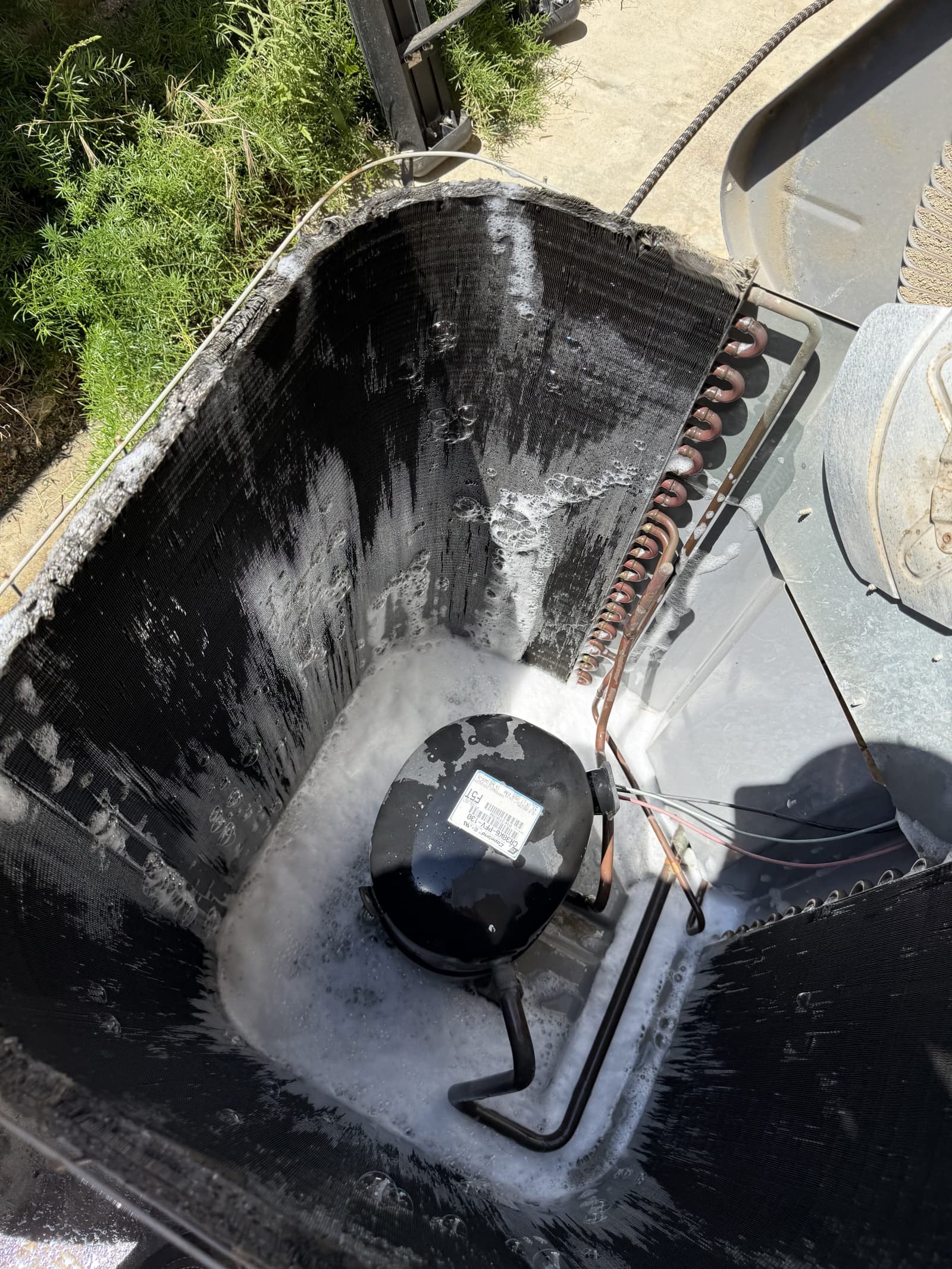
A dirty evaporator smells musty because it is wet and dusty, and the MERV number is a separate question. The maintenance visit cleans the coil and the blower as the scope describes, checks the condensate drain, and writes down what it found. A slow drain will overflow a pan and wet the cabinet insulation. That smell survives any filter until the insulation and the drain are addressed, and we say so, and we fix the wet part.
The cabinet itself leaks. A filter door that sits ajar, a missing panel screw, and a return drop open at a seam all bypass the filter. Air enters downstream of the media and lands on the coil, and on a service visit we seat the door and note the leaks. Some are a tape-and-mastic repair, and some are a new return drop, priced with the ducts.
Ultraviolet lights are sometimes installed at the coil to keep growth down on a wet surface. They are a maintenance item with a lamp life. If we install one, the quote says what it is for. The coil stays cleaner when the filter fits, the blower moves the right air, and the drain actually drains.
Ventilation, cooking, and the house as a system
Tight windows and a new roof make a house quieter, and they hold whatever you generate indoors. Cooking, especially on gas, and shower steam are indoor sources, and a range hood that recirculates keeps moisture and cooking air in the house. A bath fan that dumps into the attic raises the attic's moisture and finds its way back. Those are ventilation problems, and a filter-only pitch disappoints a household that cooks and showers.
We will tell you when the heating and cooling system is being asked to solve a ventilation problem it was never equipped for. An energy-code project that includes ventilation will say so on the Title 24 forms. Many simple changeouts leave whole-house ventilation where it was, and a filter rack is a filter rack. The building department assigns the climate zone when forms are required.
If you are comparing indoor-air add-ons on two replacement quotes, compare the filter rack depth, the MERV the blower table supports, and whether a scrubber is part of a named offer or its own line. A higher MERV number with no rack and no blower data is a restriction waiting for July.
A practical filter habit
Find the slot, whether it is in a hallway, a furnace closet, an attic drop, or a ceiling grille. Write the size down, buy the size that fits the rails, and note the arrow. The arrow points with the airflow, toward the blower and the coil. A filter in backward can collapse, and a filter in a supply grille is in the wrong job.
Check it on the first of the month. If you see a gray mat and the light barely comes through, replace it, and if it is still clean, leave it. Pets, smoke weeks, and construction shorten the interval, and an empty house lengthens it. Fontana dust and a shaded Claremont living room load at different speeds, so we skip a single day-count for every city.
The maintenance plan is our maintenance plan, with two seasonal visits, priority scheduling, and a repair discount. The visits include a look at the filter and the coil, which is when a rough MERV choice shows up as a weak temperature split. If something has failed, the repair is its own fixed price, so call (951) 713-7529, Monday-Saturday, 7:00 AM - 8:00 PM, Sunday, 7:00 AM - 4:00 PM. Next Era is based in Rancho Cucamonga, and holds CSLB #1162322, and we service Goodman, LG, Carrier, Trane, and more, and this is the homeowner version, not a filing.
Maintenance Plans
Duct Cleaning
Indoor Air Quality
Questions
Will a MERV 13 filter make the air safe?
Is the air scrubber free?
How often should I change the filter?
Can duct cleaning replace a better filter?
Based in Rancho Cucamonga
Ready for a fixed price?
Call us, or send a note. You hear the price before we start.