
seasonal · Next Era HVAC Team
After a Santa Ana, look at the condenser before you blame the compressor
After a Santa Ana, the outdoor unit can be packed with grit, palm trash, or a capacitor that quit during a power blink. If the house will not cool, look at the condenser before you assume the compressor is finished.
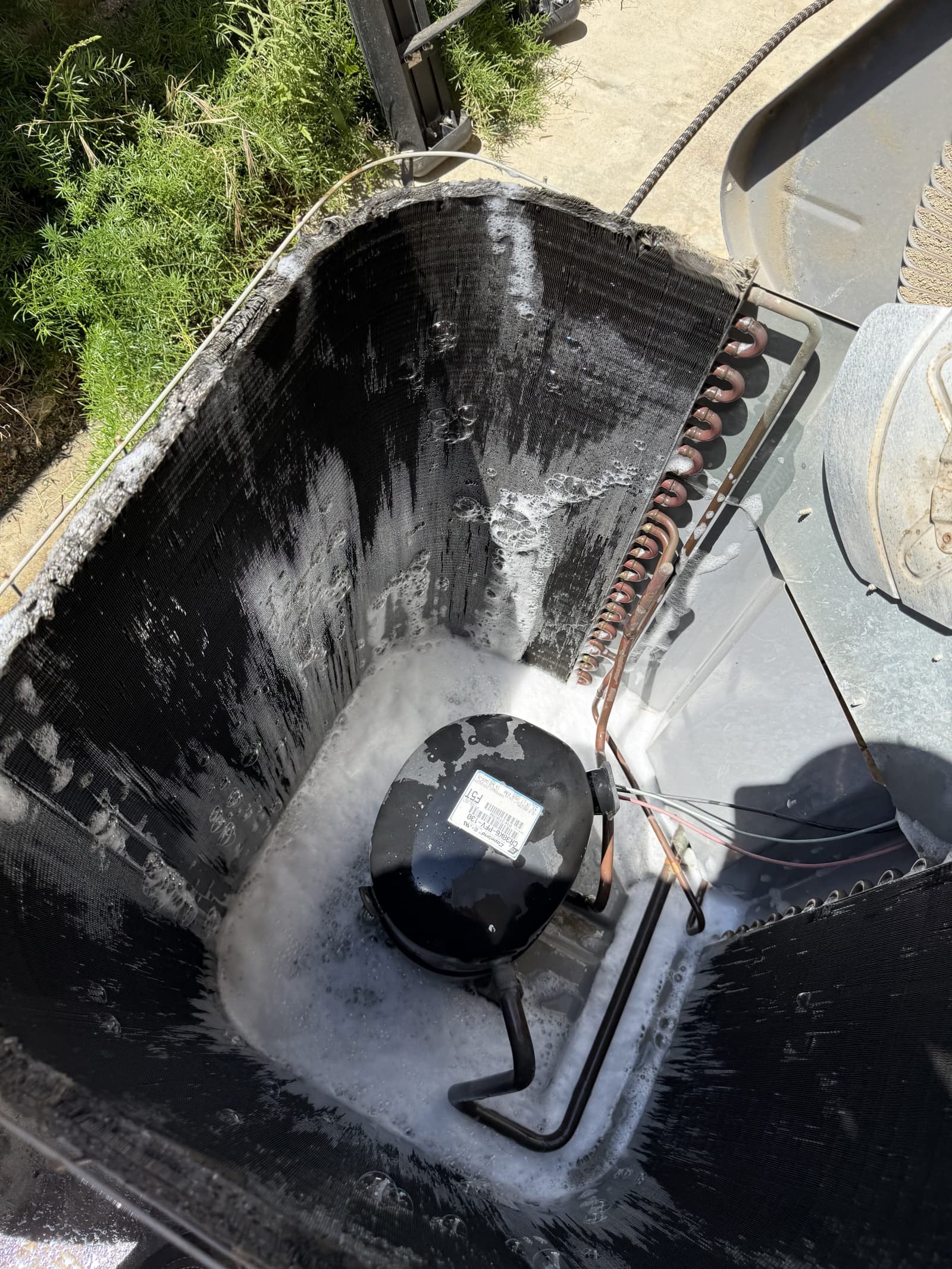
What the wind actually puts on the equipment
The wind picks up dust from open lots, warehouse corridors, and dry hillsides and drives it into the outdoor coil. Fins that were rinsed in spring can look furred after a two-day event. The same wind knocks seed heads, leaves, and palm trash against the grille. Some of that stays on the outside. Some of it gets through and sits on the fan or against the compressor blanket. A condenser is built to live outdoors. It is not built to breathe through a mat of debris.
Power blinks are the second effect. A voltage sag or a short outage during a wind event is when a weak capacitor gives up. The thermostat calls, the contactor pulls in, and the compressor hums or sits silent. That failure looks, from the hallway, like "the AC died in October," which feels unfair because the weather outside may be cooler than July. The capacitor does not care that the season is supposed to be over. It cares that it was asked to start.
Coastal cities feel the wind too, often with less dust and more salt already on the metal. Huntington Beach and the rest of coastal Orange County corrode contactors and fins on a slower schedule. A Santa Ana there is still a reason to look at the outdoor unit if the system starts making a new noise.
What you can check without opening the cabinet
After the wind drops, look at the outdoor unit from a few feet away. If a palm frond, a piece of shade cloth, or a patio cushion is sucked against the grille, the fan cannot move air. With the disconnect off, you can pull loose debris off the outside of the grille. Stay out of the fan. Do not stick a hand or a stick through the grille. Do not remove the top unless you are the technician. Do not spray the fan motor with a pressure washer.
If the fins are coated in dust and the system still cools, a gentle rinse of the outside of the coil, power off, is reasonable. If the unit is loud, grinding, or not cooling, leave the disconnect off and call. A grinding noise after a wind event can be debris in the fan. Running it "to see" bends the blade and the repair gets larger. AC repair is quoted after we see the job fixed before parts go in.
Inside the house, look at the filter. Wind-driven dust loads returns faster than a normal week. A collapsed filter will ice a coil even when the outdoor unit is clean. Check the thermostat mode. After a power blink, some controls come back in a hold, in fan-on, or with a schedule that no longer matches the household. That is a setting, not a compressor.
Noises and trips that mean stop
A buzz from the outdoor unit with no fan movement is a stop. A screech that started after the wind is a stop. A breaker that trips as soon as the system starts is a stop. Resetting a breaker once, after you have confirmed nothing is physically jammed on the outside of the grille, is as far as a homeowner reset should go. A second trip means the start components, the motor, or the compressor wants a technician. Repeated resets heat the wire and the motor.
Ice on the indoor coil or on the outdoor line set is a stop. Turn the system off and let it thaw. Ice in October can be a dirty filter, a low charge, or a blower that did not come back after the outage. It is not a reason to chip the ice off with a screwdriver, and it is not a reason to add refrigerant from a can. Leave the gauges to us. Low refrigerant is a leak. Existing R-410A can be serviced. It cannot be serviced with a hardware-store can and a hope.
If you smell burning at the disconnect or the panel, leave the breaker off and call. That smell is electrical, and it is not a coil-wash problem. The same is true of a spark or a scorched contactor you can see with the door still on. Do not open a panel to investigate a burn mark.
Why October is still a cooling month here
Santa Ana events often arrive with heat. The air is dry, the afternoons jump back into the 90s, and houses that had relaxed their setpoint suddenly need cooling again. A system that limped through September on a weak capacitor fails on the first hot windy afternoon. The calendar says autumn. The attic does not. Inland Empire attics stay extreme whenever the roof is in the sun and the outdoor air is hot, wind or no wind.
The dry air also fools people about comfort. The house can be 80°F and feel less muggy than a coastal 78. The equipment is still doing the work. A thermostat set to a deep setback during a hot Santa Ana will ask for a long recovery at the worst hour, the same way it does in July. If the system is healthy, give it time. If it is running and the supply air is warm, it is not a setback problem. It is a service call.
Heating season is close behind these winds, especially in Yucaipa, Beaumont, and the foothills. A wind event that fills a furnace vent with debris will show up as a no-heat call on the first cold morning. If you are already having the outdoor unit looked at, mention the furnace if you heard debris hit the roof. The fall heating check is the planned version of that visit.
What we do when we get there
We look at the coil, the fan, the capacitor, and the contactor before we talk about a compressor. A large share of post-wind calls are debris and a tired start component. We wash the coil, clear the fan if that is the fault, and price the part that failed before we install it. If the compressor itself is damaged, you see a repair price and a replacement price when replacement is the honest option.
The seasonal tune-up is the visit to book before wind season if the system has not been seen since spring. The maintenance plan is the version with two visits a year. Neither one repairs a system that is already down. Restrictions may apply. Call for details.
Call (951) 713-7529, Monday-Saturday, 7:00 AM - 8:00 PM, Sunday, 7:00 AM - 4:00 PM. Tell us the city, whether the outdoor unit is running, and whether the noise started during the wind. That is enough for us to roll the right visit.
Questions
What the wind actually puts on the equipment?
What you can check without opening the cabinet?
Based in Rancho Cucamonga
Ready for a fixed price?
Call us, or send a note. You hear the price before we start.