
city · Next Era HVAC Team
The coast and the Inland Empire do not load a house the same way
We work the coast and the Inland Empire, and a condenser that is happy in one climate gets misread in the other. Salt air and a mild afternoon are a different job from a 100 degree attic.
Heat, hours, and the attic
Inland afternoons in the upper 90s and low 100s, with heat waves above that, are the design condition for Rancho Cucamonga, Fontana, Riverside, and their neighbors. The attic above the hallway is hotter than the yard for a long run of hours. Flex duct and the air handler live in that heat. Capacitors and coils fail in clusters during the first hot week because the equipment has been held at that condition day after day.
Coastal Orange County, Huntington Beach and the cities that actually get a marine layer, has milder peaks and fewer of those hours. The house still needs cooling, and a west-facing slider still matters. The attic still gets hot when the sun is on the roof. It does not get hot in the same sustained way. A rule of thumb carried from Fontana to the coast will oversize. A rule of thumb carried from the coast inland will undersize. We do not use either rule. Manual J is the calculation.
Degree-days are a climate statistic. They are not a load calculation and they are not a quote. The building department assigns the Title 24 climate zone when a form needs one. Weather talk on this page is not that assignment. This is not legal advice.
Moisture and salt
Latent load, the moisture the coil removes, is higher near the coast than in the dry inland valley, and it is higher still on a few desert days when monsoon moisture arrives. An oversized coastal system short-cycles and does a poorer job of drying the air. The house can hit the setpoint and still feel clammy. That complaint is less common in Fontana in June and more common in a beach city in the same month. Equipment selection has to notice.
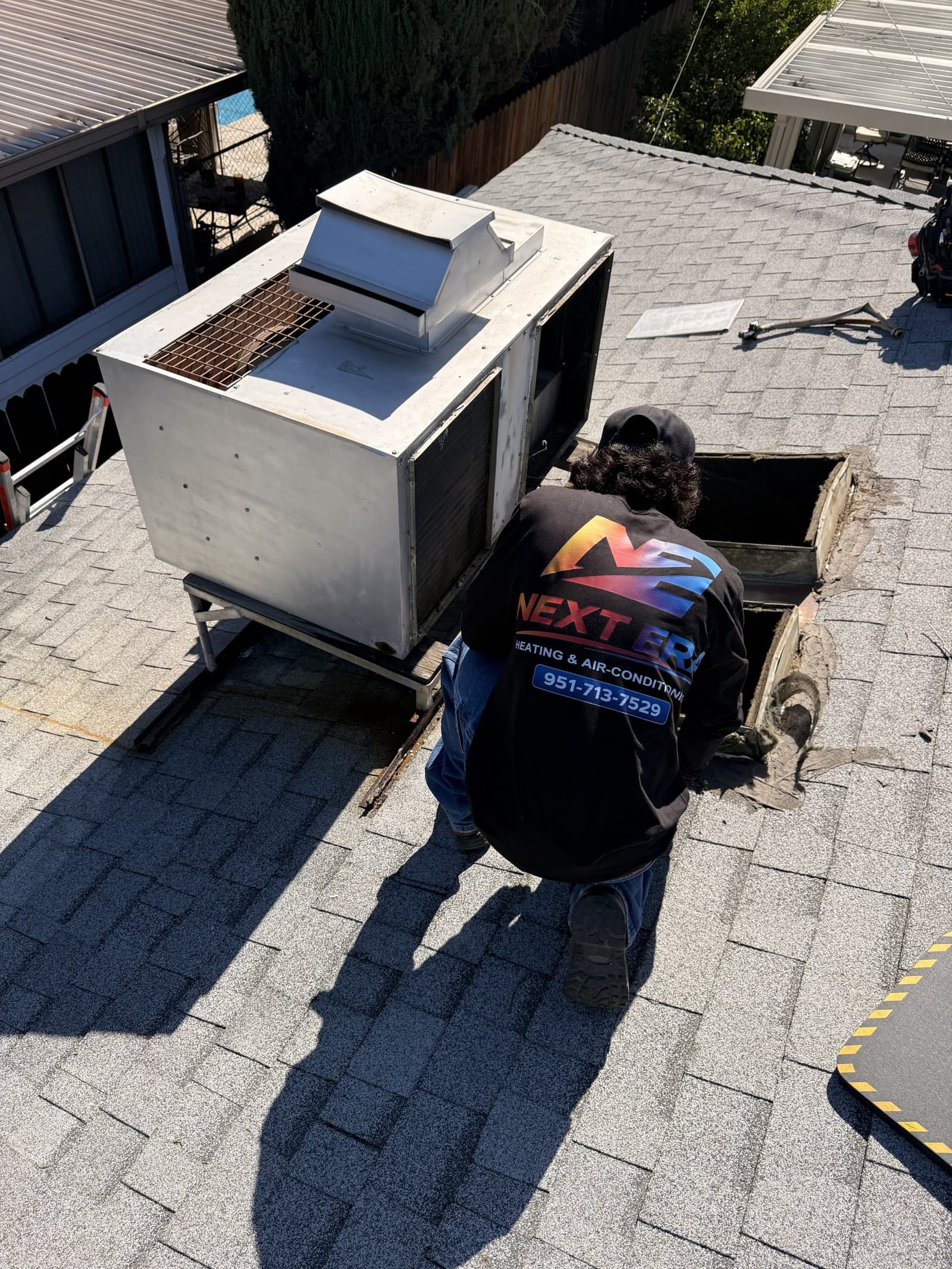
Salt air is the coastal maintenance fact. Contactors pit, fins corrode, and electrical connections age in a way a dry inland coil does not. The checklist on a seasonal tune-up is the same: filter, coils, refrigerant check, electrical, thermostat, written summary. The failure we are looking for is different. Inland, we are looking at dust packed into the fins. On the coast, we are looking at metal that has been in salt air since the last visit. Desert package units add roof heat and sand. Three versions of "the coil is dirty."
Filters still matter in both places. Coastal houses are not exempt from a choked return, and inland houses are not exempt from corrosion if they sit near an industrial plume or a pool. The local pattern is a tendency, not a permission to skip half the system.
Heating is a different season in each place
Coastal furnaces can go a long time between real heating demands. When they fail, it is often a flame sensor that has been dusty since spring, on a morning that is merely cool. Pass and foothill cities, Yucaipa, Beaumont, Banning, and the north edges of the valley, use heat for real nights in the 30s. A heat pump or a furnace there is a winter appliance. A coastal heat pump is mostly an air conditioner that happens to be able to heat.
SoCalGas serves most of the gas houses on both maps. Electric utilities do not match. Anaheim Public Utilities, Southern California Edison, and the municipal utilities inland send different bills. Operating-cost comparisons between a furnace and a heat pump have to start from the bill, not from the county name. We will not print a savings percent for "Orange County" or "the IE."
Electric strips on a heat pump are a bigger risk as a misconfiguration than as a climate requirement near the coast. Inland and in the pass they are a real backup. The thermostat setup has to match the place and the equipment. A free smart thermostat comes with a complete install.
Same prices, different scopes
The quotes do not change when the truck crosses a county line. Call for a free estimate on repair, replacement, heat pumps, ducts, cleaning, and mini-splits. The scope changes. A coastal condenser in a side yard is not a Palm Springs crane set. An inland attic full of crushed flex is not a coastal closet furnace with a short duct. The fixed price follows the scope we see, which is why a phone quote that ignores the city is not a quote.
SEER2 minimums are federal Southwest minimums, and California is in that region on both sides of the county line. Under 45,000 Btu/h, split air conditioners installed on or after January 1, 2023 meet 14.3 SEER2 and 11.7 EER2. The hot-condition rating matters more inland and in the desert, where the expensive hours are hotter. It still belongs on a coastal quote, because the law and the certification do not stop at the 55 freeway. The SEER2 M1 test is not the old SEER rating.
Ask about current offers on a qualifying system, and about current offers for seniors, military, and first responders. Restrictions may apply. Call for details. These offers have no end date. They are not utility rebates, and we do not invent dollar amounts for Edison, SoCalGas, or Anaheim Public Utilities.
One office, two climates
Tell us the city when you call. Huntington Beach and Hemet are both on the service list, and they are not the same diagnosis. Hours are Monday-Saturday, 7:00 AM - 8:00 PM, Sunday, 7:00 AM - 4:00 PM, at (951) 713-7529. We work on all the big names: Goodman, LG, Carrier, Trane and more.
If you moved from the coast to the Inland Empire, or the other way, have the system maintained for the climate you are in now. A filter schedule from a breezy coastal house will be too long for Jurupa Valley dust. A capacitor that was fine in Irvine may already be tired after two Fontana summers. Spend the first season in the new climate on a tune-up before you decide the house came with a bad air conditioner.
Bring the symptoms that match the place: salt and corrosion, dust and attic heat, or desert roof equipment. The written note from a maintenance visit turns those symptoms into a price.
Questions
What should a homeowner know about this: Heat, hours, and the attic?
What should a homeowner know about this: Moisture and salt?
Based in Rancho Cucamonga
Ready for a fixed price?
Call us, or send a note. You hear the price before we start.