
symptoms · Next Era HVAC Team
The air conditioner is running and the house is still warm
The thermostat says cool, the system is making noise, and the rooms are still warm. A few checks are safe before you call, and the refrigerant circuit is the part we would rather handle on the visit.
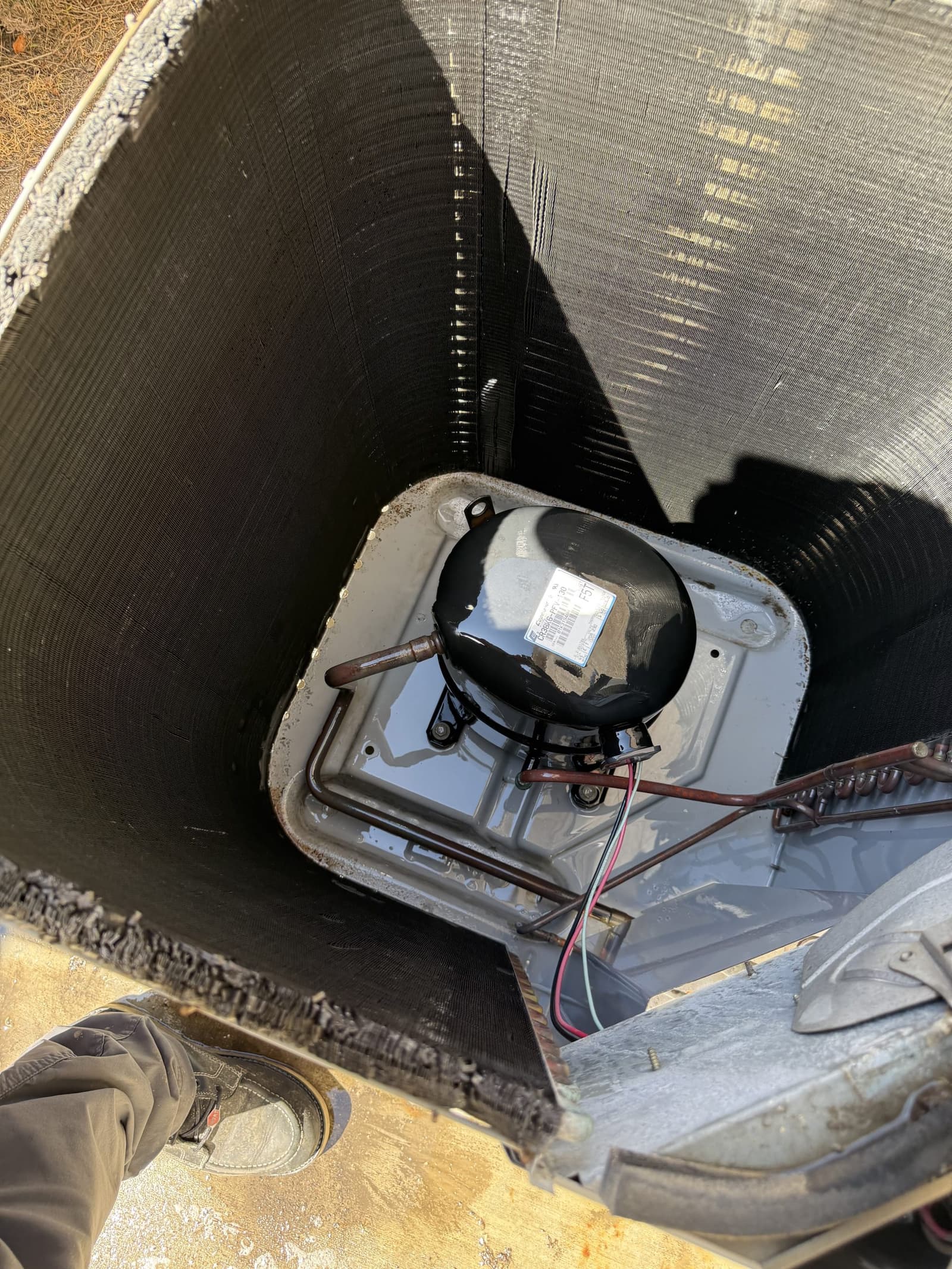
Confirm it is actually calling for cooling
Set the mode to cool and the setpoint several degrees below the room temperature. A schedule, a hold, and a wrong mode are responsible for a surprising number of "no cool" calls. Fan set to on will run the blower forever. The air from the supply can feel mild because the coil is not running, and the house never catches up. Put the fan on auto while you test.
See whether the outdoor unit is running or only humming. A hum with no fan, or a fan with no compressor sound, is a failed start component or a failed motor more often than it is a mystery. See whether the indoor blower is moving air. Supply air that is clearly cool means the refrigeration circuit is doing something, and the problem may be volume: a filter, a duct, or a room with the register closed. Supply air that is room-temperature, with both halves running, is a repair.
Replace or remove a filter that is collapsed or packed. If the system starts cooling within a few minutes of a filter change, you found it. If the coil was iced, turn the system off and let it thaw before you judge. Chipping ice, or running the system to "blow the ice off" while the coil is a solid block, bends fins and can send water into the cabinet. Let it melt. Find the float switch if a pan is full, and do not jumper it.
The outdoor unit, from outside the cabinet
Turn the disconnect off before you pull debris off the grille. Leaves, a pad, a plastic bag, and grown shrubs against the discharge are ordinary. Stay out of the fan. Do not remove the top panel. Do not spray water into the electrical compartment. A gentle rinse of dusty fins, power off, is reasonable. A pressure washer is how fins fold over and airflow gets worse.
If the breaker tripped, reset it once after the disconnect has been off and the grille is clear. If it trips again, leave it off and call. A second trip is a failed component asking for heat, and the heat is in the wire and the motor. Do not replace a breaker with a larger one to keep the system running. That is how a temporary no-cool becomes a damaged compressor or a damaged panel.
Listen. A new grind after a windstorm can be debris in the blade. A click and a hum can be a capacitor. Both are AC repair calls, fixed before parts. Neither one is improved by running the unit "until the technician gets here" if the noise is metal on metal.
What we do not want you to open
Do not buy refrigerant and add it. A warm house and a running system can be low on charge, and low charge means a leak. Adding refrigerant without fixing the leak wastes the gas and repeats the call. R-410A, the refrigerant in most existing central systems, has a global warming potential near 2,090 and is not a hardware-store project. R-454B and R-32 are not drop-in substitutes. Leave the gauges to us. If you already added a can, tell the technician. It changes the diagnosis.
Do not open the furnace cabinet and touch wiring to "see if the capacitor looks bad." Capacitors hold a charge. Do not jumper a safety switch. Do not bypass a float switch so the pan stops shutting the system down. The pan is full for a reason. A wet ceiling is the next step if you force the system to run.
Do not assume the compressor is dead because the house is warm. A packed condenser, a failed capacitor, a thermostat in the wrong mode, and a disconnected duct all produce a warm house with a system that "runs." The repair visit separates those. If the compressor is actually failed, you will get a repair price and, when it makes sense, a replacement price. System replacement is quoted after we see the job. We do not skip the simple failures to get there.
Ducts and rooms that never had air
If one room is warm and the rest of the house is cool, the branch to that room is the suspect. A closed register, a crushed flex run, or a collar that fell off in the attic will do it. The thermostat cannot see that room. Opening every other register and replacing the filter is the homeowner portion. Reconnecting a duct in a 140°F attic is the technician's portion in July, and it is a reasonable thing to schedule in the morning.
If the whole house is evenly warm and the supply air is barely cool, the system is not moving enough heat. Dirty coils, low charge, a weak compressor, and a blower running at the wrong speed live in that category. The seasonal tune-up is the visit when the system still sort of works and you want it measured. The repair visit is the visit when it has already failed. The Comfort Club plan is $24.99/mo or $299.88/yr if this is the second summer you have had the same almost-cooling week.
A smart thermostat will not repair this. If the screen is lit and the call is correct, the control has done its job. Replacing it because the house is warm spends money on the wrong object. We include one free on a complete install. We do not sell one as a substitute for a repair.
When you call
Tell us the city, whether the outdoor unit is running or humming, whether the indoor blower is moving air, whether the filter was loaded, and whether any ice was on the coil. Say if a breaker tripped. Those facts are the useful phone report. Call (951) 713-7529, Monday-Saturday, 7:00 AM - 8:00 PM, Sunday, 7:00 AM - 4:00 PM.
If the house is dangerously hot and someone in it is vulnerable, treat that as the emergency it is. Cooling centers and medical help sit outside an HVAC visit. We can still roll a repair.
A free second opinion is available if another company condemned the compressor from the driveway. Ask what they measured. You get a fixed price before parts, whether the answer is a capacitor or a new system. Restrictions on offers may apply.
Questions
What should a homeowner know about this: Confirm it is actually calling for cooling?
What should a homeowner know about this: The outdoor unit, from outside the cabinet?
Based in Rancho Cucamonga
Ready for a fixed price?
Call us, or send a note. You hear the price before we start.